The landscape of the American workforce is undergoing a seismic shift, driven by rapid advancements in biotechnology, renewable energy, and materials science. As we move through 2026, the chemical sciences have emerged as the backbone of innovation, bridging the gap between theoretical molecular research and industrial application. For graduates and professionals, this era represents a “Golden Age” where traditional roles are being redefined by automation and AI-driven discovery.
Success in this evolving market requires more than just a mastery of the periodic table; it demands an interdisciplinary approach where data literacy meets lab expertise. However, the academic rigor required to reach these high-stakes positions can be overwhelming for many students. If you find yourself struggling with complex reaction mechanisms or thermodynamic equations, it is often wise to seek professional guidance. Many top-tier candidates often decide to do my chemistry homework to ensure they maintain the high GPA necessary for competitive recruitment in the pharmaceutical and green energy sectors.
1. Medicinal Chemist (Pharmaceutical & Biotech Specialization)
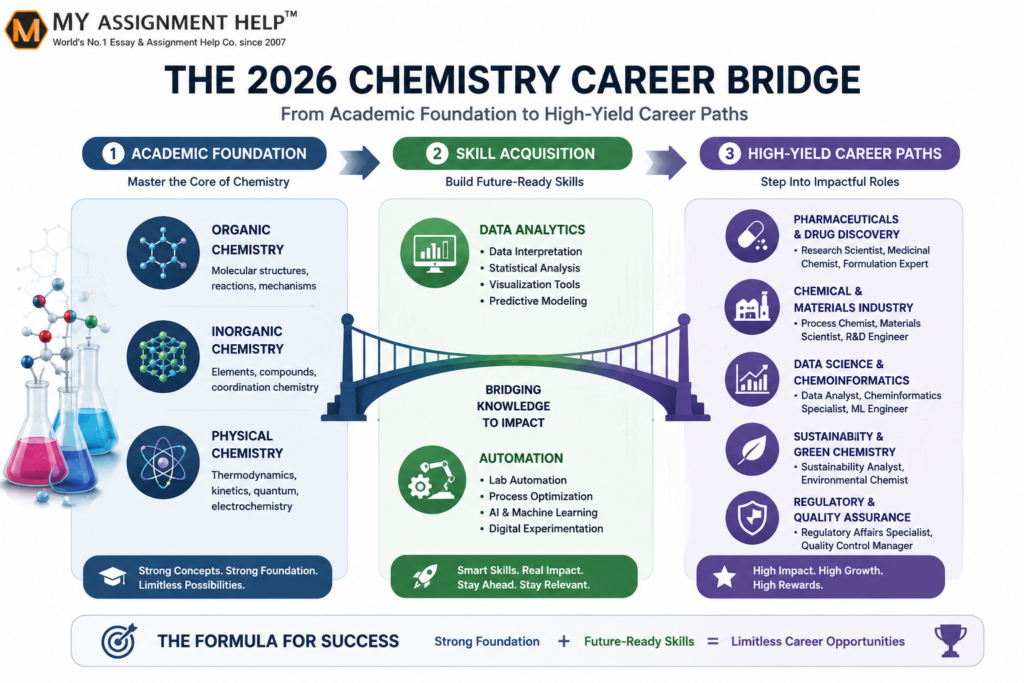
Medicinal chemistry remains the crown jewel of the US chemistry market. In 2026, the focus has shifted toward personalized medicine and mRNA-based therapeutics. Companies like Pfizer, Moderna, and Vertex are aggressively hiring chemists who can design, synthesize, and analyze new drug candidates using computer-aided drug design (CADD).
According to the Bureau of Labor Statistics (BLS) and industry reports, the demand for medicinal chemists has grown by 8% annually. The integration of high-throughput screening and machine learning in drug discovery has transformed the laboratory into a data-driven hub.
- Average Salary (2026): $118,000 – $165,000
- Key Skills: Organic Synthesis, Molecular Modeling, SAR Analysis.
2. Environmental & Sustainability Chemist
With the US government’s “2030 Net-Zero” milestones approaching, sustainability chemistry has transitioned from a niche interest to a corporate necessity. These professionals work on “Green Chemistry” initiatives, reducing the environmental footprint of chemical manufacturing and developing biodegradable materials.
The role involves optimizing chemical processes to adhere to the principle of atom economy, where the formula for efficiency is often viewed as:
% Atom Economy = (Mass of Desired Product / Total Mass of All Reactants) × 100
Industries ranging from plastics to textiles are seeking experts who can replace toxic solvents with sustainable alternatives.
- Average Salary (2026): $95,000 – $142,000
- Key Skills: Life Cycle Assessment (LCA), Regulatory Compliance (EPA), Waste Minimization.
3. Materials Scientist (Semiconductors & Battery Tech)
As the US seeks to decouple its supply chain from foreign dependencies, domestic semiconductor and EV battery manufacturing have exploded. Materials scientists are the architects behind the next generation of solid-state batteries and high-efficiency silicon wafers. This role is crucial for the “CHIPS and Science Act” initiatives that continue to fund domestic tech hubs in 2026.
| Industry Sector | Projected Growth (2026) | Top US Hubs |
| Semiconductors | 12% | Arizona, Texas, Oregon |
| Battery Storage | 15% | Michigan, Nevada, Georgia |
| Aerospace Materials | 7% | Washington, California |
4. Chemical Data Scientist (Cheminformatics)
Perhaps the most transformative role of 2026 is the Chemical Data Scientist. This hybrid professional uses Python, R, and specialized software to manage the massive datasets generated by modern laboratory instruments. They bridge the gap between traditional chemistry and silicon-based simulations.
In an increasingly digital academic landscape, students often look to myassignmenthelp for comprehensive help with homework when navigating the intersection of coding and chemical theory. This interdisciplinary support is vital as the curriculum shifts toward computational chemistry.
- Average Salary (2026): $125,000 – $180,000
- Key Skills: Python/R, Cheminformatics, Statistical Analysis.
5. Forensic Toxicologist
Public health challenges and the modernization of the legal system have increased the need for advanced forensic toxicology. In 2026, forensic chemists are utilizing ultra-high-performance liquid chromatography (UHPLC) and mass spectrometry to detect complex synthetic substances with unprecedented precision. These roles are found in both government laboratories (FBI, DEA) and private diagnostic firms.
- Average Salary (2026): $88,000 – $130,000
- Key Skills: Mass Spectrometry, Analytical Chemistry, Legal Testimony.
Key Takeaways for 2026
- Interdisciplinary Mastery: Combining chemistry with data science or environmental policy yields the highest salaries.
- Geographic Hubs: Texas, Massachusetts, and California remain the primary drivers of chemical employment.
- Education Matters: While a B.S. is entry-level, a Master’s or PhD significantly increases lifetime earnings in R&D.
- Soft Skills: The ability to communicate complex data to non-technical stakeholders is a critical differentiator.
See also: How to Track Crypto Trends
Frequently Asked Questions
Q: What is the highest-paying chemistry job for entry-level graduates?
A: In 2026, entry-level roles in Cheminformatics and Materials Science for the semiconductor industry offer the highest starting salaries, often exceeding $90,000 in tech-heavy regions.
Q: Is a PhD mandatory for these high-paying roles?
A: While not always mandatory for roles in manufacturing or quality control, a PhD is typically required for Lead Research Scientist positions in medicinal chemistry and advanced materials R&D.
Q: How has AI affected chemistry careers in the US?
A: AI has automated repetitive lab tasks but increased the demand for chemists who can interpret AI-generated molecular models and manage automated synthesis platforms.
About the Author
Dr. Aris Thorne is a Senior Content Strategist and Academic Consultant at MyAssignmentHelp. With a PhD in Analytical Chemistry and over a decade of experience in the US pharmaceutical industry, Dr. Thorne specializes in bridging the gap between academic theory and industrial application. He frequently contributes to career guidance forums, helping the next generation of chemists navigate the complexities of the modern job market.
References:
- U.S. Bureau of Labor Statistics (2025). Occupational Outlook Handbook: Chemists and Materials Scientists.
- American Chemical Society (ACS). 2026 Salary Survey and Employment Trends.
- National Science Foundation (NSF). The State of U.S. Science and Engineering 2026.
- “The AI Revolution in Molecular Discovery,” Journal of Chemical Information and Modeling (2026).